Lost in Venice: The Scenic Secrets Most Tourists Never See
Walking through Venice feels like stepping into a dream where water replaces streets and silence echoes between ancient walls. I didn’t expect to fall so hard for its hidden corners—the quiet canals, forgotten bridges, and golden light that paints the buildings at dusk. This isn’t just a city; it’s a living painting. And once you look beyond the crowds, Venice reveals a beauty most travelers never even know exists. Beyond St. Mark’s Square and the Rialto Bridge lies a quieter Venice, one that hums with the rhythm of daily life, where reflections shimmer on still water and time slows beneath arched stone bridges. To truly know this city is to wander with curiosity, to pause where others rush, and to discover the delicate balance between decay and elegance that defines its soul.
Arrival in Venice: First Impressions Beyond the Postcard
Most travelers arrive in Venice by train, stepping off at Venezia Santa Lucia, a modest station that opens directly onto the Grand Canal. The first sight—a wide curve of water framed by ochre and rose-colored buildings, gondolas bobbing beside vaporetti—feels almost theatrical, as if the city has staged its grandest scene just for newcomers. Yet just beyond this postcard moment lies a different Venice, one that unfolds only when the initial awe settles. The key to accessing it begins with mindset: patience, presence, and the willingness to move slowly. Unlike cities built for speed, Venice rewards those who resist the urge to check off landmarks.
Piazzale Roma, the mainland terminus where cars stop and footpaths begin, marks another threshold. From here, the city swallows you whole—no engines, no horns, only footsteps on stone and the occasional call from a delivery boat. This sudden silence is jarring at first, then soothing. It signals a shift not just in transportation but in consciousness. Most tourists follow the signs to Rialto or San Marco, funneling into narrow alleys already crowded by 9 a.m. But those who turn left toward Cannaregio or right into Santa Croce, even for a short walk, immediately sense a change. The air feels cooler, the voices quieter, the pace more natural.
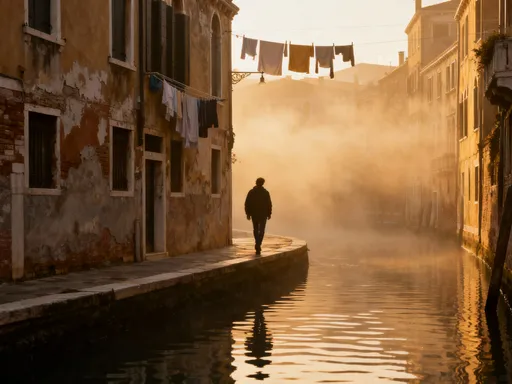
Early morning, between 6:30 and 8:00 a.m., offers the purest experience of Venice’s transformation. Mist rises off the canals, and the city wakes gently. Fishermen unload crates at the Rialto Market long before the stalls open to the public. Bakers pull fresh bread from ovens, their shops glowing warmly in the dim light. At these hours, the city breathes. It is not performing. This is when Venice feels most real—unfiltered, unhurried, and unafraid of its own stillness. Arriving with time to spare, rather than rushing to the next attraction, sets the tone for a deeper kind of travel.
The Magic of Light: Venice’s Most Overlooked Scenic Asset
Of all Venice’s gifts, light may be the most fleeting and profound. It does not merely illuminate the city—it reshapes it. At dawn, the low sun skims across the lagoon, turning the water into liquid gold. By midday, the light sharpens, casting crisp shadows from bell towers and palazzos. At sunset, especially in late summer and early autumn, the entire city seems to glow from within, as if lit by an invisible fire behind the walls. This interplay of light and water is not just beautiful; it is central to understanding Venice’s soul.
The Bacino di San Marco, the wide expanse of water between St. Mark’s Basin and the lagoon, is one of the best places to witness this phenomenon. From the waterfront near the Doge’s Palace, the morning sun reflects off the marble façades of the Procuratie, doubling their grandeur in rippling mirror images. But even more striking are the quieter zones, like the eastern edge of Castello, where the canals run narrow and long. Here, during golden hour, the light slips between buildings, painting one wall in warm amber while leaving the opposite side in deep blue shadow. The effect is cinematic, yet entirely natural—a daily masterpiece few tourists stay long enough to see.
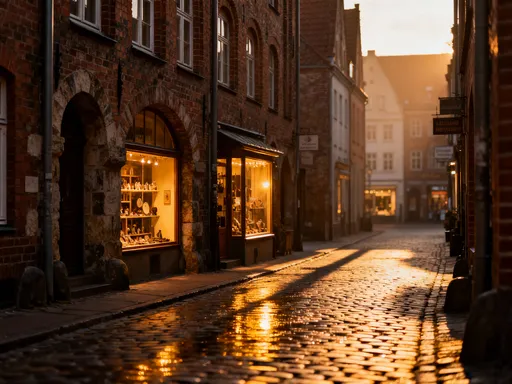
Photographers often plan their itineraries around light, but casual travelers can benefit just as much from its rhythms. A walk through the Dorsoduro district at sunset reveals how sunlight catches the edges of terracotta rooftops and gilds the corners of centuries-old doors. Even on overcast days, Venice’s reflective surfaces—wet cobblestones, canal waters, polished stone steps—amplify whatever light is available, creating a soft, diffused glow. Understanding these patterns allows visitors to move with the city’s natural rhythm rather than against it. Timing a visit to a quieter canal or a secluded campo to coincide with the best light transforms an ordinary stroll into a moment of quiet wonder.
Hidden Canals: Escaping the Grand Canal Crowds
The Grand Canal, with its palatial facades and constant traffic of boats, is undeniably impressive. But its popularity comes at a cost—noise, congestion, and a sense of being herded from one viewpoint to the next. To find Venice’s true serenity, one must turn away from the main waterways and follow the smaller canals, known locally as *rii*. These narrow, winding passages form the city’s hidden circulatory system, threading through neighborhoods where life unfolds at a human scale.
The Cannaregio district, stretching north from the train station, is home to some of the most peaceful waterways. The Rio di San Girolamo and the Rio della Sensa offer quiet beauty—overhanging laundry, flower-filled balconies, and the occasional cat watching from a windowsill. These canals are rarely featured in guidebooks, yet they reveal the city’s daily poetry. Along their banks, elderly neighbors exchange greetings in Venetian dialect, and children walk to school carrying small leather satchels. There are no souvenir shops here, no gondoliers calling for fares—just the gentle lap of water against stone and the occasional creak of a wooden door.
Further south, in Dorsoduro, the Rio dell’Orso and the Rio San Vio offer similar tranquility. These canals are so narrow that a person could stretch their arms and touch both sides. Gondolas rarely pass through; instead, small service boats deliver groceries and building supplies to homes accessible only by water. Walking along the fondamenta (the paved pathways beside the canals), one becomes aware of how intimately connected Venetians are to the water—not as a spectacle, but as a practical, ever-present force.
For travelers, the best way to experience these hidden canals is on foot, following no fixed route. Wearing comfortable shoes and carrying a simple map—or better, no map at all—allows for spontaneous discovery. Turning down an alley simply because it slopes toward water, or pausing at a bridge to watch a fisherman cast his line, leads to moments of unexpected beauty. Avoiding the gondola-heavy zones not only reduces noise but also increases the chances of witnessing authentic Venetian life. These quieter routes do not offer grand monuments, but they offer something more valuable: a sense of place, of belonging, even if only for an hour.
Bridges That Tell Stories: Beyond Rialto and Accademia
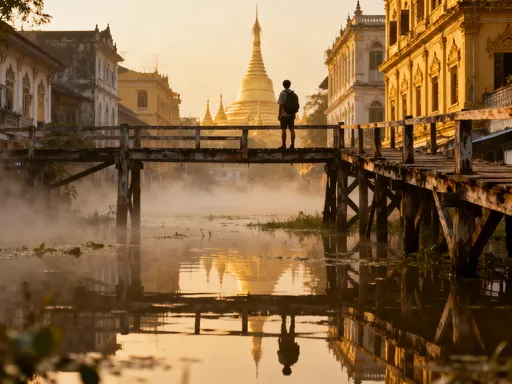
Visitors often measure Venice by its famous bridges—the ornate Rialto, the glass-floored Accademia, both engineering feats and tourist magnets. Yet the city’s true character lies in its smaller, unnamed bridges, hundreds of which arch over narrow canals like quiet sentinels. These structures, built from Istrian stone and worn smooth by centuries of footsteps, connect neighborhoods in ways that maps cannot capture. They are not destinations, but transitions—moments of pause between one world and the next.
Some of the most evocative bridges are found in the Castello and San Polo districts, where foot traffic is light and the views are unobstructed. A simple stone arch over the Rio di Ca’ Foscari, for instance, offers a framed glimpse of a weathered palazzo reflected in still water. Another, near Campo Santa Maria Formosa, curves gently over a dark canal where a single laundry line stretches between buildings, swaying slightly in the breeze. These bridges do not have plaques or guidebook entries, yet they speak volumes about the city’s quiet dignity.
The act of crossing them becomes a ritual. Stepping onto the worn center stone, pausing to look down the canal, feeling the slight incline beneath your feet—these small sensations ground the traveler in the physical reality of Venice. Unlike the wide, flat walkways of the major bridges, these smaller ones require attention. You must slow down, balance your steps, and look where you’re going. In doing so, you become part of the city’s rhythm rather than a spectator of it.
Finding these bridges requires no special skill, only curiosity. They appear unexpectedly—around a corner, at the end of a narrow calle, beside a quiet wellhead. Some are so low that tall travelers must duck slightly; others are so narrow that two people must step aside to pass. Yet each offers a unique perspective, not just of the water, but of the life that unfolds beside it. A child’s bicycle leans against one railing, a potted plant sits atop another, a faded flag flutters from a nearby window. These details, fleeting and unremarkable to locals, become treasures to those who notice them. The best views in Venice, it turns out, are not the ones everyone photographs—but the ones you stumble upon when you’re not looking.
Piazzas Without the People: Finding Stillness in Sacred Spaces
While St. Mark’s Square draws millions each year with its majestic basilica and lively cafés, it rarely offers peace. The same cannot be said for Venice’s smaller piazzas—its *campi* and *campielli*—which serve as the quiet hearts of neighborhoods. These open spaces, often centered around a church, well, or shaded tree, pulse with local life but remain largely untouched by mass tourism. They are where Venetians gather to chat, where children play after school, and where time seems to stretch rather than race.
Campo Santa Maria Formosa, tucked between Castello and San Marco, is one such refuge. Bounded by a 15th-century church and rows of faded pastel buildings, it exudes calm. In the early evening, elderly residents sit on benches, watching the light fade from the bell tower. A small grocery store at one corner stocks essentials for nearby apartments, and the scent of espresso drifts from a family-run bar. Unlike the grand squares, this campo has no souvenir stands, no amplified music, no guided tour groups. It simply exists—unselfconscious and unhurried.
Another gem is Campo San Giacomo di Rialto, said to be the oldest square in Venice. Located just steps from the bustling Rialto Market, it feels worlds apart. Here, a single café with green awnings has served locals for generations. At midday, merchants from the market stop for a quick meal of cicchetti—small Venetian tapas—washed down with a glass of white wine. The church of San Giacomo, with its ancient stone column carved with astrological symbols, stands as a quiet witness to centuries of daily life. Sitting here with a notebook or a camera, one feels not like a tourist, but like a temporary neighbor.
These spaces offer more than aesthetic pleasure; they provide emotional respite. In a city where every alley seems designed for Instagram, the quiet piazzas remind visitors that Venice is, first and foremost, a home. They invite stillness. They allow for reflection. And they reveal a truth often missed by those chasing landmarks: that beauty is not always loud, and significance does not require a crowd. Visiting these squares at dawn or late evening, when the light is soft and the footsteps few, deepens their impact. They become not just places to see, but places to feel.
Art in Plain Sight: Murals, Masks, and Faded Elegance
Most travelers associate Venetian art with the masterpieces of Titian and Tintoretto, housed in grand museums and churches. But another kind of artistry thrives in the open air—unofficial, unsanctioned, and often overlooked. It appears in the peeling paint of a 17th-century wall, the hand-carved family crest above a doorway, the faded fresco barely visible beneath centuries of grime. This is the art of endurance, of beauty born not from perfection but from time.
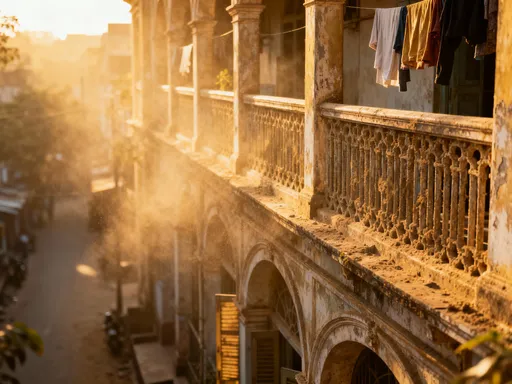
In the quieter corners of Cannaregio and Castello, one can find walls layered with decades of paint, each chip revealing a different era. Blues and ochres bleed into one another, creating abstract compositions no gallery could replicate. Nearby, wrought-iron balconies sag under the weight of potted geraniums, their rust blending with the red of the flowers. These details are not curated—they are lived-in, imperfect, and deeply expressive. They tell stories of families who have lived here for generations, of buildings that have survived floods and time.
Equally compelling are the glimpses of craftsmanship still alive in the city. In small workshops near San Polo, artisans shape papier-mâché into elaborate carnival masks, painting them with gold leaf and intricate patterns. The windows display these creations like jewels, glowing under soft light. Though the carnival itself is a spectacle, these quiet studios preserve the soul of the tradition. Similarly, hand-painted signs—advertising a cobbler, a bakery, or a family-run osteria—add a personal touch in an age of digital fonts. Each stroke of the brush carries intention, a refusal to surrender to uniformity.
Walking through residential zones with an eye for these details transforms a simple stroll into a scavenger hunt of beauty. A child’s drawing taped to a door, a mosaic step worn smooth by footsteps, a shutter painted in a bold green that hasn’t faded—these are the city’s quiet declarations of identity. They reflect a culture that values subtlety, resilience, and continuity. To notice them is to honor the real Venice, not as a museum piece, but as a living, breathing community that continues to create, even in the smallest ways.
The Real Venice: How to Travel Like You’re Part of the City
To experience Venice fully is to shift from sightseeing to sensing. It means moving beyond checklists and allowing the city to reveal itself in its own time. This kind of travel is not about efficiency, but about presence. It begins with choices—where to stay, where to eat, how to move. Staying in a neighborhood apartment rather than a hotel near St. Mark’s Square immediately changes the relationship to the city. Waking up to the sound of church bells, buying bread from the same bakery each morning, learning the names of local shopkeepers—these small acts create a sense of belonging.
Eating where locals eat is another key. Instead of tourist-focused restaurants with multilingual menus, seek out osterie tucked into back alleys, where the daily specials are written on a chalkboard and the wine is served in carafes. Cicchetti bars, especially in the late afternoon, offer a chance to mingle with residents enjoying an after-work drink. Ordering simply—perhaps a slice of polenta with baccalà, or a small plate of marinated seafood—connects you to the rhythms of Venetian life.
Using public transportation like the vaporetto as a local does—riding Line 1 from the north to the south of the city, watching the changing skyline from the deck—offers a fluid perspective no walking tour can match. Getting off at lesser-known stops like Sant’Elena or San Zaccaria allows for spontaneous exploration. Returning to the same spot at different times of day reveals how the city transforms—how light, sound, and energy shift with the hours.
Ultimately, the most meaningful travel is not measured in photos or landmarks visited, but in moments of connection. It is the old woman who smiles as you pause to take in a view, the fisherman who nods as you cross his favorite bridge, the scent of lemon trees drifting from a hidden garden. These are the memories that endure. Venice, for all its grandeur, is not a monument to be conquered. It is a living, breathing place, fragile and beautiful, waiting not to be seen, but to be felt. To lose yourself in its quiet corners is not to be lost at all—but to find something far more precious: a deeper way of seeing the world.